




Endemic Species of the Congo Basin

Not all species carry equal conservation weight. Endemics, species whose entire global range falls within a single landscape, represent an absolute conservation responsibility: if lost here, they are lost entirely. Within the Congo Basin, that responsibility is acute. Their presence signals intact, functioning ecosystems. Where endemics persist, the forest is working.

  • Okapi

  • Eastern Lowland Gorilla

  • Congo Peafowl

  • Bonobo

  • Itombwe Forest Chameleon

Great Apes

The Congo Basin is the global stronghold for great apes, home to every species except the orangutan. Its forests support significant populations of chimpanzees, bonobos, western gorillas, eastern lowland gorillas, and mountain gorillas – yet all face mounting threats from habitat loss, poaching, disease, conflict, and forest fragmentation.

The Democratic Republic of Congo is particularly important for great ape conservation as it is the only country in the world home to both the eastern lowland gorilla (Gorilla beringei graueri) and the bonobo (Pan paniscus), two endemic species found nowhere else on Earth. The Congo Basin also contains one of the world’s last remaining populations of mountain gorillas (Gorilla beringei beringei), whose survival depends on intensive long-term protection, transboundary collaboration, veterinary monitoring, and careful management of the human-wildlife interface.

Beyond their ecological importance, great apes are also highly vulnerable to human pressures due to their slow reproduction, genetic closeness to humans, and susceptibility to infectious diseases.  Protecting them demands integrated approaches that combine habitat conservation, community engagement, disease prevention, scientific monitoring, and landscape connectivity across Central Africa. 

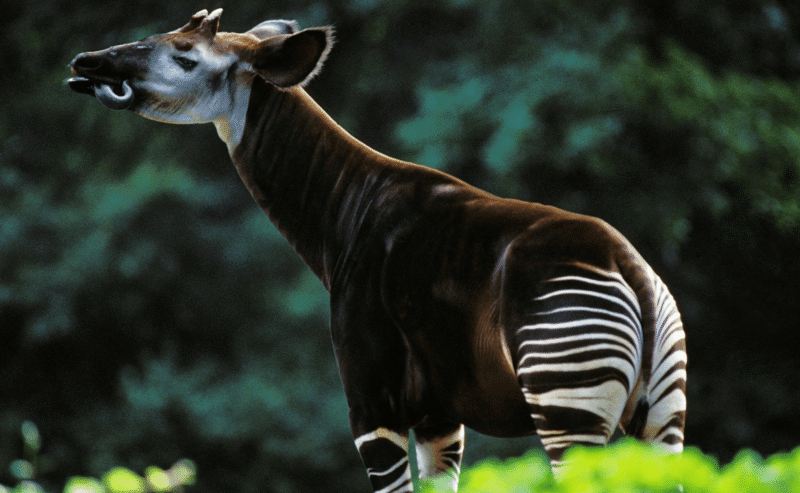
Okapi

The okapi (Okapia johnstoni), often referred to as the “forest giraffe,” is one of the Congo Basin’s most iconic and evolutionarily unique species, found nowhere in the world outside the Democratic Republic of Congo. Although closely related to the giraffe, the okapi remained largely unknown to the outside world until the early twentieth century due to its secretive behavior and the dense forest habitats it occupies.

Okapi inhabit the tropical forests of northeastern Congo and are considered an important indicator species for the health and integrity of intact forest ecosystems. Their survival depends on large continuous forest landscapes that are increasingly threatened by habitat degradation, illegal mining activities, armed conflict, deforestation, bushmeat hunting, and expanding human pressure across the Congo Basin.

Because okapi occur only within the DRC, their conservation represents both a national and global responsibility. 

Protecting okapi habitat simultaneously safeguards broader forest ecosystems that support thousands of other species, major freshwater systems, and globally important carbon reserves.

Forest Elephants

The Congo Basin contains some of the world’s last remaining populations of African forest elephants, a species now classified as Critically Endangered by the IUCN. Forest elephants play a critical ecological role within tropical forest ecosystems as major seed dispersers and ecosystem engineers, helping maintain forest structure, biodiversity, and long-term carbon storage capacity. However, forest elephant populations have experienced catastrophic declines in recent decades due primarily to ivory poaching, habitat fragmentation, armed conflict, and expanding human pressure across Central Africa. Recent assessments estimate that only approximately 135,000 forest elephants remain across their range, with some studies documenting population declines of more than 80% in parts of the Congo Basin over the last several decades.  

The long-term survival of forest elephants depends not only on species protection itself, but also on maintaining large connected forest landscapes and ecological corridors capable of supporting viable populations over time. 

As roads, extractive activities, agricultural expansion, and fragmentation continue to penetrate previously intact forests, the preservation of connected ecosystems across the Congo Basin becomes increasingly important for both biodiversity conservation and broader ecological resilience.